Remote Assessment for Practical Skills
Remote assessment means an assessor can judge practical performance without being in the room when the task happens. With Remote Reviewer, learners and workplace teams record real tasks at the workplace, workshop, site or classroom. Assessors then review that evidence against defined criteria in their own time, and the outcome is kept as a structured record.
What is remote assessment?
Remote assessment is a way to capture and review evidence of performance when the assessor, trainer, supervisor or moderator does not need to be physically present. It suits tasks, observations, role plays, compliance checks and workplace activities that can be recorded and then reviewed against defined criteria.
Live observation relies on the assessor and learner being in the same place at the same time. Remote assessment separates the two. The learner completes the task where it naturally happens, and the assessor reviews the recorded or linked evidence when they are available. That is useful for distributed cohorts, regional and remote learners, shift-based workplaces and sites where an extra visitor is impractical.
Remote assessment is not a shortcut around assessment design. It works best when the task is clearly defined, the criteria are shared and agreed, and there is a process for asking for more evidence when a recording does not show enough.
What remote assessment changes
Teams usually adopt remote assessment for three practical reasons:
- Assessors are not tied to one location. Reviews can happen across locations, rosters and time zones, so a smaller team of assessors can support learners in many places without travelling to each one.
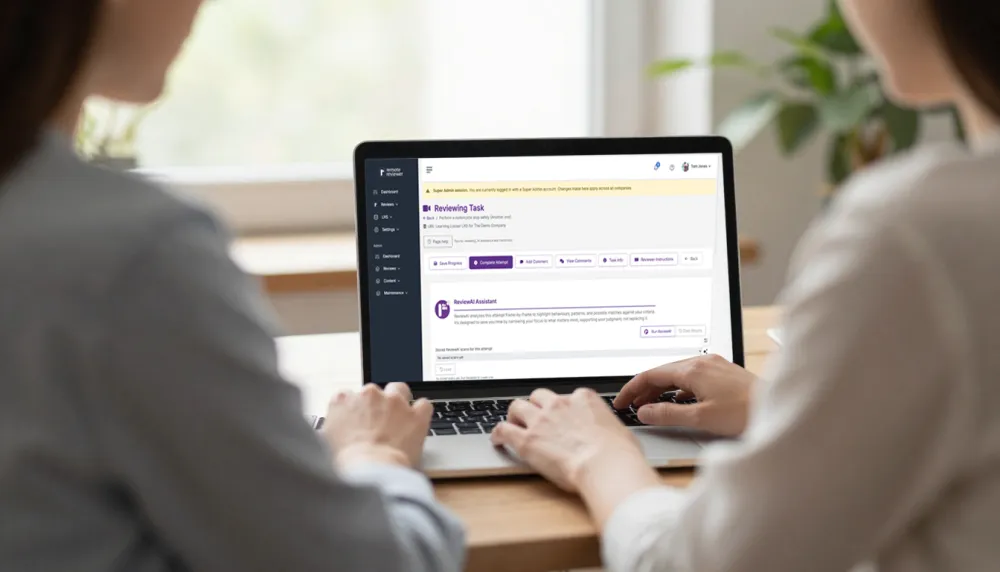
- Reviews are more consistent. Every reviewer works from the same evidence requirements, task criteria and checklist, which means less depends on how one individual observer approaches a live session.
- Decisions are easier to explain. The evidence, reviewer comments and outcome are retained together, so a decision can be revisited, moderated or reported on later. That is not possible when a live observation leaves only handwritten notes behind.
Built for teams assessing practical work at a distance
Remote assessment is designed for organisations that need to review practical evidence and workplace performance without falling back on email chains, shared drives and manual file handling.
- RTOs and vocational education providers reviewing practical demonstrations and workplace evidence from learners spread across employers, regions and cohorts.
- Workplace training and compliance teams confirming that required procedures and behaviours are performed correctly at sites the assessor cannot easily visit.
- Safety and operations teams reviewing compliance checks, site practices and operational tasks when access, travel or timing is constrained.
- Recruitment and employability programs assessing mock interviews, communication tasks and practical preparation activities without scheduling every session live.
- Scenario-based assessment teams reviewing role plays, simulations and observed scenarios with input from more than one reviewer.
How a remote assessment works
Remote Reviewer keeps the process simple for candidates and field teams, and gives reviewers a structured way to assess what they did not see live:
- Set the assessment tool or evidence requirement. Define what needs to be demonstrated and map the criteria to the relevant unit of competency, so every remote reviewer assesses against the same standard.
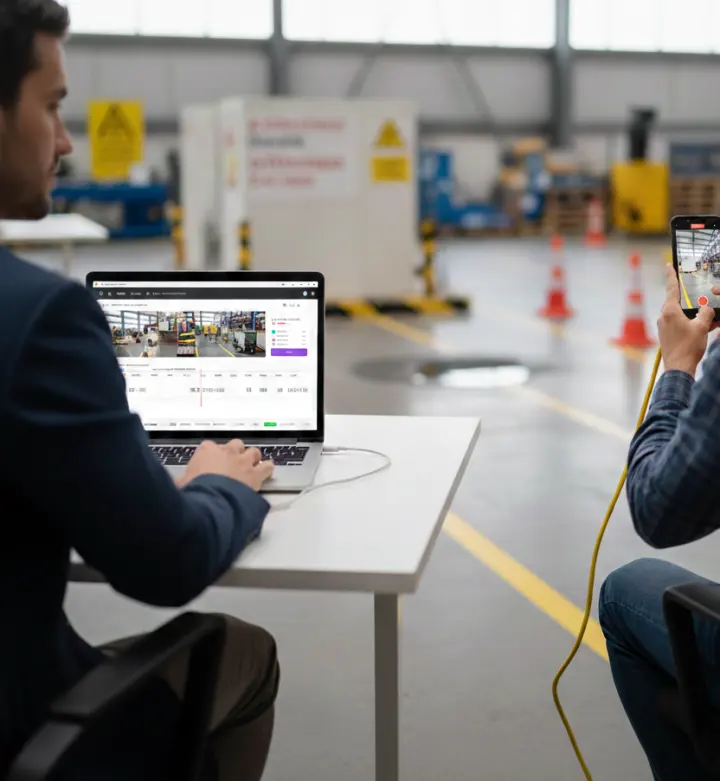
- Capture or upload evidence on location. The candidate, or a workplace supervisor, records video or audio, or provides linked files, from the workplace, workshop, field or classroom. The free companion app makes this practical on a phone.
- Review against an observation checklist or rubric. The assessor works through the criteria remotely, adding timestamped comments so the decision rests on evidence that is valid, sufficient, authentic and current.
- Confirm the outcome and store the record. The outcome, assessor sign-off and evidence are retained as a structured record, including xAPI statements where they are configured.
Remote assessment vs live observation vs file sharing
Remote assessment differs from live-only observation and ad hoc file sharing in one key way: it combines recorded or linked evidence with structured review and a lasting record.
| Factor | Remote assessment | Live observation | Ad hoc file sharing |
|---|---|---|---|
| Assessor must be present | No | Yes | No |
| Works across locations and time zones | Yes, asynchronous | No, must be scheduled live | Partly, but unstructured |
| Structured criteria and rubrics | Yes, built in | Depends on the assessor | No, applied manually |
| Evidence can be re-reviewed and moderated | Yes | No, unless separately recorded | Only if files are retained |
| Durable record of the decision | Yes, xAPI-backed where configured | Limited to notes | Scattered across inboxes |
| Reviewer collaboration | Yes | Hard to coordinate | Manual and error-prone |
Planning evidence for an assessor who is not there
Because the assessor cannot ask questions in the moment, a remote task needs clearer instructions than a live one. Tell the candidate exactly what to show, the conditions to work under, whether the full sequence must appear in one recording, and how to frame the camera so the important actions are visible and audible.
Authenticity needs more attention when nobody is watching live. Remote Reviewer can prompt candidates for consent and self-identification before they record, and each accept or decline is stored with the time, device and exact wording shown. Workplace supervisors can also help capture performance in context, while the assessor keeps responsibility for the decision.
Assessors should still check whether the recording shows enough to meet the criteria and ask for further evidence when it does not. Remote assessment also needs a plan for privacy, access to recordings and your organisation’s retention obligations.
Remote assessment under the 2025 Standards for RTOs
The 2025 Standards for Registered Training Organisations took effect on 1 July 2025, replacing the 2015 Standards. They put more weight on outcomes and demonstrated practice than on written policies alone.
A structured remote assessment workflow keeps the evidence, assessor sign-off and decision history together. That supports valid assessment, evidence quality and record keeping, and gives you records to draw on for risk-based validation and moderation. Being able to show how a task was performed, and how it was reviewed against the rules of evidence, can make remote decisions easier to explain over time.
Remote Reviewer does not replace your student management system or LMS, and it does not make compliance decisions for you. Your RTO remains responsible for assessment design, assessor judgement, validation and its regulatory obligations. See the VET and RTO resources for more detail.
What supports remote assessment in Remote Reviewer
These capabilities matter most when the assessor and the candidate are in different places:
- Structured evidence capture. Recorded video and audio tasks, linked evidence and supporting files, with clear evidence requirements for each task.
- Companion mobile app. Candidates on iOS and Android can sign in, record or upload evidence and see reviewer feedback from their phone, which suits field and workplace settings. About the app.
- Reviewer workflow and collaboration. Assigned reviewers and task sets, timestamped comments, assessor sign-off recorded with each decision, and support for more than one reviewer or moderator on the same evidence.
- Consent records. Configurable consent and self-identification prompts, with the full consent history visible on the review.
- LMS integration (LTI 1.3). On plans with API access, learners record or upload from inside Moodle or another LTI 1.3 platform, and pass/fail results return to the gradebook. Explore LMS integration.
- xAPI-backed records. Assessment outcomes can be stored as xAPI statements in your own Learning Record Store or a provided one, so remote assessment records are not locked inside a single tool.
- ReviewAI. An assistive capability that points reviewers to likely relevant evidence and checks submissions against your requirements. The reviewer always makes the final decision.
Where remote assessment is a strong fit
These evidence-led use cases show where a remote workflow is clearer than live-only observation or disconnected file sharing: remote skills assessment, construction skills assessment, workplace risk assessment, ESL speaking practice, mock interview review, presentation skill feedback and childcare scenario assessment.
Remote Reviewer also supports barista observation, VR medical procedure review and pre-flight task evidence. See all use cases.
Remote assessment terms, defined
Plain-language definitions, so teams new to remote assessment share the same vocabulary:
- Remote assessment: capturing and reviewing evidence of a task, performance or scenario against defined criteria without requiring the assessor to be physically present.
- Asynchronous review: the assessor reviews evidence after it has been captured, rather than watching it live.
- Observation checklist: a structured list of criteria a reviewer works through when assessing recorded or linked evidence.
- Rubric: a set of criteria and performance levels used to assess evidence consistently across candidates and reviewers.
- Rules of evidence: the principle that assessment evidence should be valid, sufficient, authentic and current.
- Moderation: a quality process in which reviewers cross-check decisions to confirm they are consistent and applied to the same standard.
- Risk-based validation: a validation approach that prioritises which assessments to review based on risk, drawing on the records kept for each decision.
- xAPI and Learning Record Store (LRS): xAPI is a specification for recording learning and assessment activity as portable statements. An LRS receives and stores those statements.
Frequently asked questions
What is remote assessment?
Remote assessment is the process of capturing and reviewing evidence of a task or performance without requiring the assessor to be physically present. The candidate completes the task where it happens, and the assessor reviews the evidence against defined criteria afterwards.
What kinds of evidence can be assessed remotely?
Video, audio, linked evidence and supporting files can be reviewed against a checklist, rubric or structured task set.
Is remote assessment suitable for vocational training and workplace assessment?
Yes, where the task can be captured safely and the evidence shows what the criteria require. It suits vocational training, workplace assessment, compliance checks, practical tasks and scenario-based review. Some tasks may still need direct observation, questioning or supplementary evidence.
How do you confirm authenticity when the assessor is not present?
Remote Reviewer can prompt candidates for consent and self-identification before recording, and stores every response with the time, device and wording shown. Clear task instructions, workplace supervisor involvement and follow-up questioning can also help. The assessor decides whether the evidence is authentic.
Can multiple reviewers assess the same remote evidence?
Yes. Remote Reviewer supports workflows where more than one reviewer or moderator assesses the same evidence, which helps with moderation and validation.
Can candidates submit evidence from a phone?
Yes. The free Remote Reviewer companion app for iOS and Android lets candidates sign in, record or upload evidence and see reviewer feedback, which makes remote assessment practical in field and workplace settings.
Does it integrate with our LMS?
Yes. Remote Reviewer connects to Moodle and other LTI 1.3 platforms on plans with API access. Learners record or upload inside the course, and pass/fail results return to the gradebook.
Do I need my own Learning Record Store?
No. You can use your own LRS if you already have one, or use a provided option for a simpler setup.
How do I get started with remote assessment?
Choose one practical task, define the evidence requirement and criteria, then start a free Remote Reviewer account to test the remote workflow with a small group.